If you’re new to F1 or haven't been paying attention, the current F1 cars are turbocharged, and have been since 2014. I’m sure the majority of my readers will already that, but how many of you really give a thought about the packaging of the engine, and what’s required to fit the technology into an F1 car.
It needs to be lightweight, efficient and compact. In many cases you can’t have all three.
Until Conflux came along that is, having built a great reputation for being known as the company that designed and manufactured cooling components for Formula 1 cars.
What they designed is a great example of how motorsport innovates, passing down technology to road vehicles.
Their 3D printed barrel intercooler (charge cooler) is now on sale to builders.
16 kilos of intercooler, replaced by 1.4.
The 3D printed air-to-water intercooler, central to the Donkervoort and Conflux collaboration cut weight from 35.3lb to 3.1lb on the P24 RS. The car it cools makes 600 hp and weighs 780 kg, running a twin 1.4 kg barrel water charge air cooler layout.
3D printed F1 parts are now being built into road cars and the performance jump is wild
I’m very big on motorsport innovations, but "F1 technology" is one of the most abused phrases in the automotive industry. So, when a small Australian company says its intercooler comes from Formula 1, you should be sceptical.
After digging into it, the claim holds up.
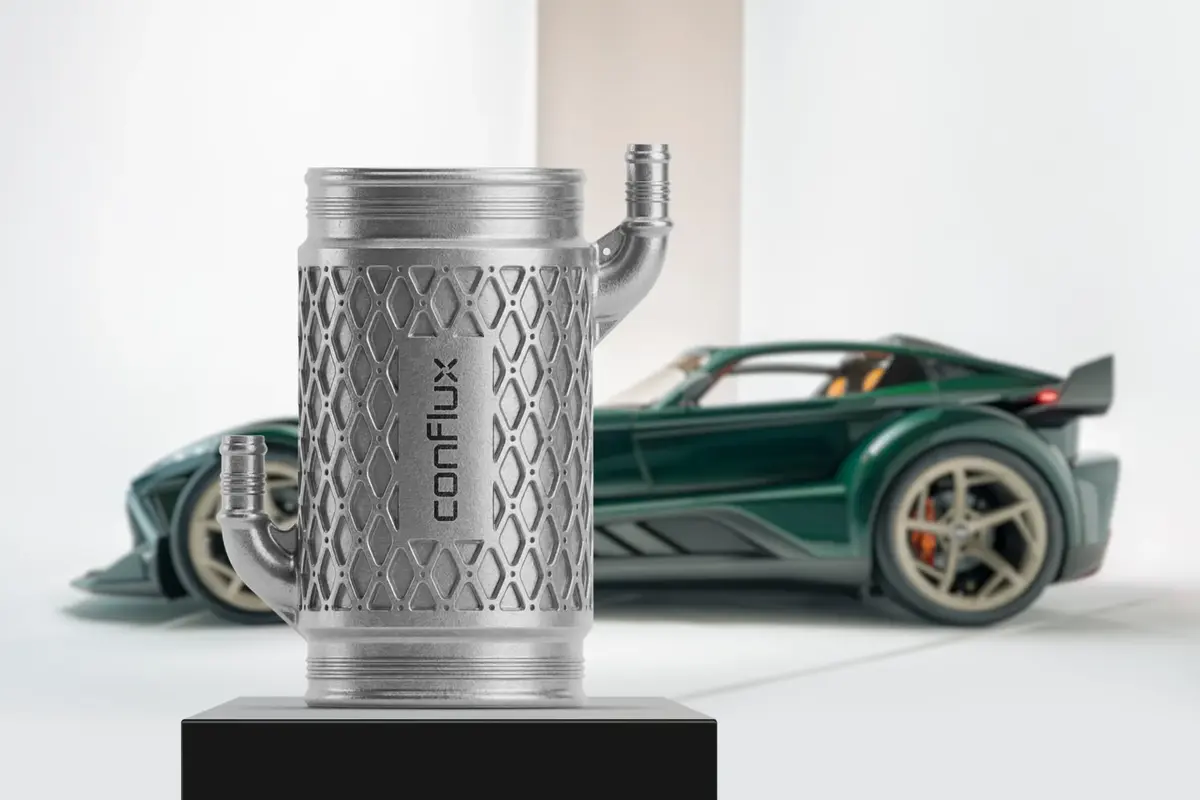
The Conflux barrel intercooler and the Donkervoort P24 RS it cools.
© Conflux
Is Conflux Really F1 Technology?
Yes.
Conflux says the idea for an additively manufactured heat exchanger came out of European F1 in 2014, where Conflux Founder, Michael Fuller spent more than 15 years as a senior engineer on championship-winning Formula One, World Rally and Le Mans prototype cars. He patented the company's first heat exchanger in 2015.
Conflux doesn't name which F1 teams uses its parts, which is normal in a paddock that guards its suppliers closely. Either way, it's the same core design method and manufacturing process, scaled for road and club racing engines.
Fuller makes honest use of the phrase “F1 derived”:
"Our Formula 1 technology is available beyond the track for the first time."
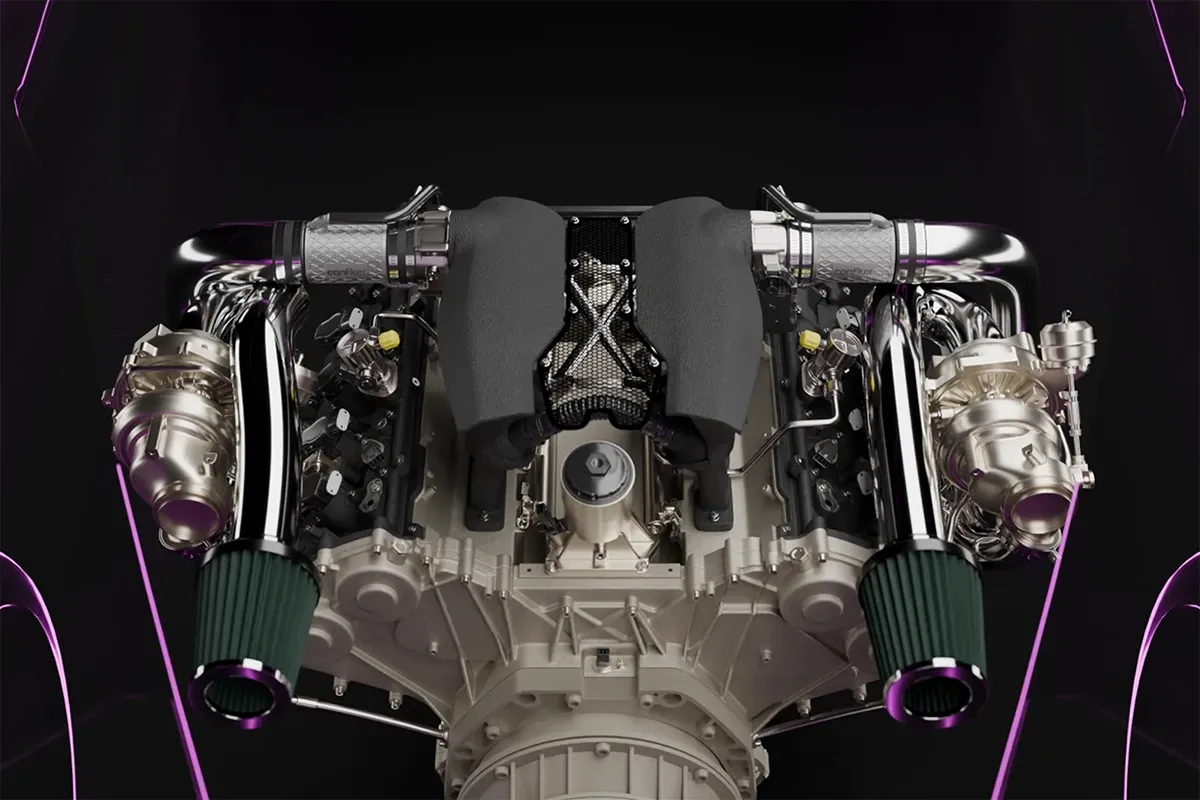
Mounted inline, the barrels shorten the path from turbo to engine.
© Conflux
How It's Used, From the Grid to the Road
Teams moved to water-to-air intercooling because the cooler can be smaller than a chunky intercooler, and no longer needs to sit in the airflow, which let Ferrari and Mercedes tuck it in front of the engine.
It wasn’t all advantages, compromises were made. The water-to-air layout was heavier and ran a higher charge air temperature, but temperatures stayed more consistent, especially at low speeds or sitting on the grid.
It was a compromise, but the packaging benefit was worth it to the teams that made the switch. Keep that packaging benefit, and cut the weight and temperature penalties that came with it.
On the Donkervoort, the cylindrical coolers sit directly between the turbochargers and throttle bodies, each printed with fin geometry, density and size tailored to the engine. Design News reported this creates an intake tract roughly one third of the usual length, which improves throttle response because there's less intake charge mass to move.
It's worth mentioning that Conflux's products aren’t limited to charge air. Pagani uses its cartridge heat exchangers on the Utopia, and Xtrac uses its technology in transmission cooling.
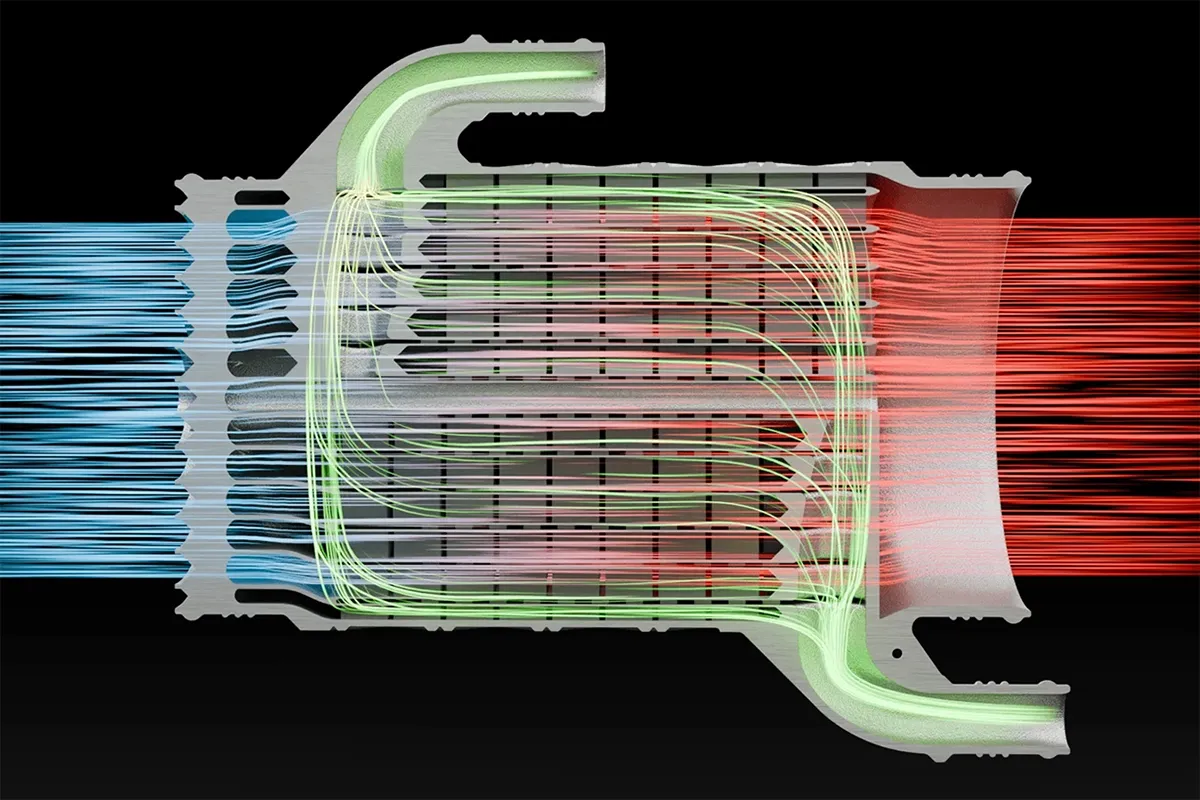
A cutaway of the Conflux Core, with coolant paths shown in green.
© Conflux
Why It Works So Well
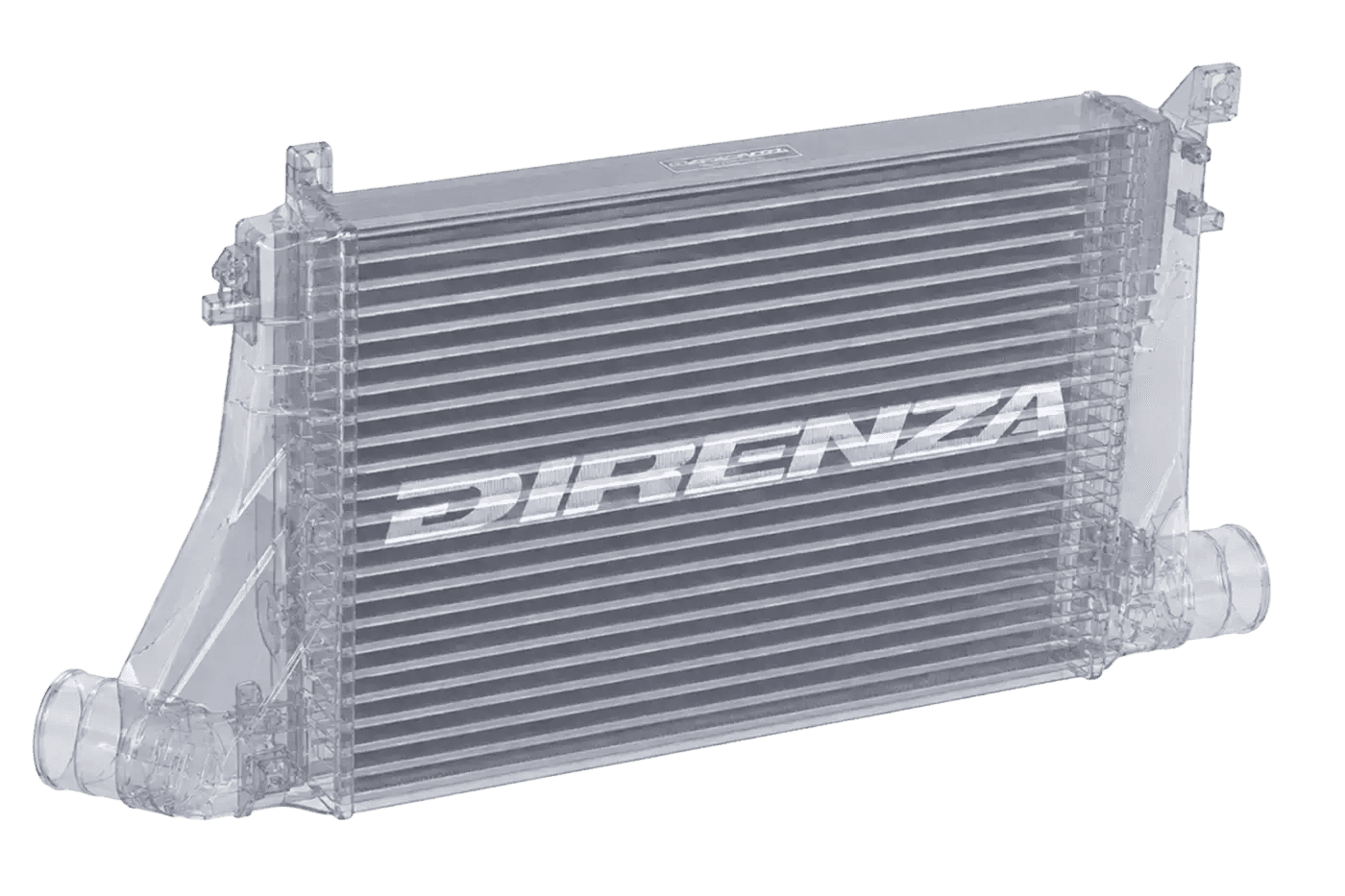
A conventional intercooler core is built from flat tubes and folded fins, brazed together. Its shape is limited by what you can bend, stack and braze.
Conflux’s 3D printing technology doesn't have that limitation. The cores are printed by laser powder bed fusion (LPBF), which allows the internal channels can take whatever shape the heat transfer needs. It’s this design method that gives the flexibility for it to pack far more surface area into a given volume, combined with shaped fluid pathways and 3D surface features.
The Metrics
At launch, Conflux claimed the following against leading microtube water charge air coolers at the same heat exchange:
- 15% smaller core volume
- 24% less air-side pressure drop
- 82% less coolant pressure drop
- 31% lighter dry and 39% lighter wet
A later case study pushes the air side further, quoting a 44% reduction in air-side pressure drop.
Why should you care about pressure drop?
Every psi lost across the core is a psi your turbo has to produce again. Asking your compressor to work harder, generating even more heat than it needed to in the first place. Conflux specifically cites avoiding the mass, ducting and turbo work penalties of conventional air-to-air intercoolers. A secondary benefit to less heat is lower coolant pressure drop. It means a smaller pump can move enough water through the core.
The metrics above are Conflux's own figures, so treat them as claims until you've seen the curves. Which is easy. You can ask for them.
Conflux offers indicative performance curves, boundary conditions and validation context for the barrel range on request.
Why Rivals Will Struggle to Copy It at First
Anyone with a metal 3D printer could produce a barrel that looks similar. Matching the performance is the hard part. The simulations, experience (and brains), with real-world testing is not something anyone can do. I'd stop right there, because there is another roadblock for anyone else out there wanting to compete.
The design is protected. Conflux has held patents on its additively manufactured heat exchanger since 2015.
Even if you could legally reproduce this design, you won’t be able to manufacturer it cheaper by manufacturing it with conventional methods. The geometry needs the intricate production process. Its performance comes from a geometry that can only be made using additive manufacturing, so conventional intercooler makers cannot retool to get the same result.
Capacity is expensive. Fuller describes printing as a slow process, where going faster means better machines or more capital equipment.
Conflux runs CFD and FEA to predict how each geometry performs, then confirms it against physical testing. It’s the decade of experience that allows them predict a core before printing it.
Conflux worked with Deakin University on new aluminium alloys specifically for its printed heat exchangers, instead of using any old conventional material.
Fuller calls Conflux "an inch-wide, mile-deep company" focused on managing heat transfer only. Potential competitors couldn’t catch up us with quickly. I'd expect credible competitors eventually, but not any time soon.
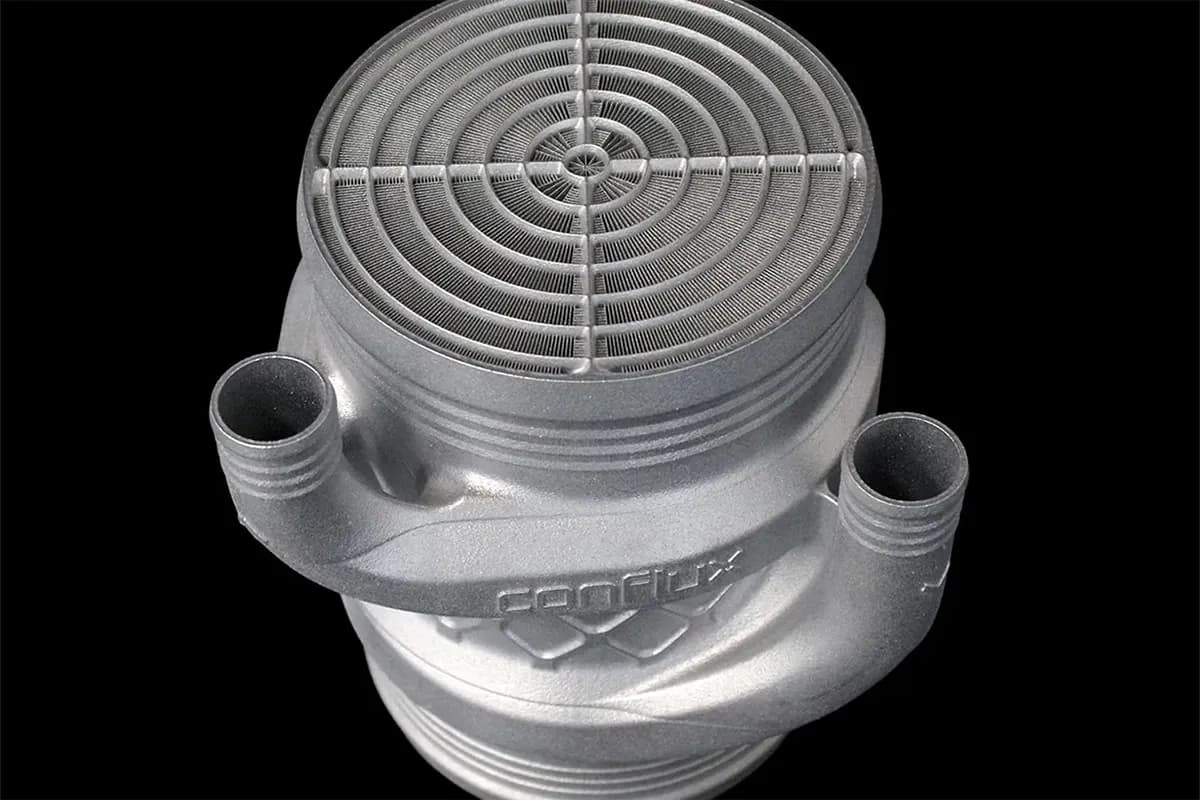
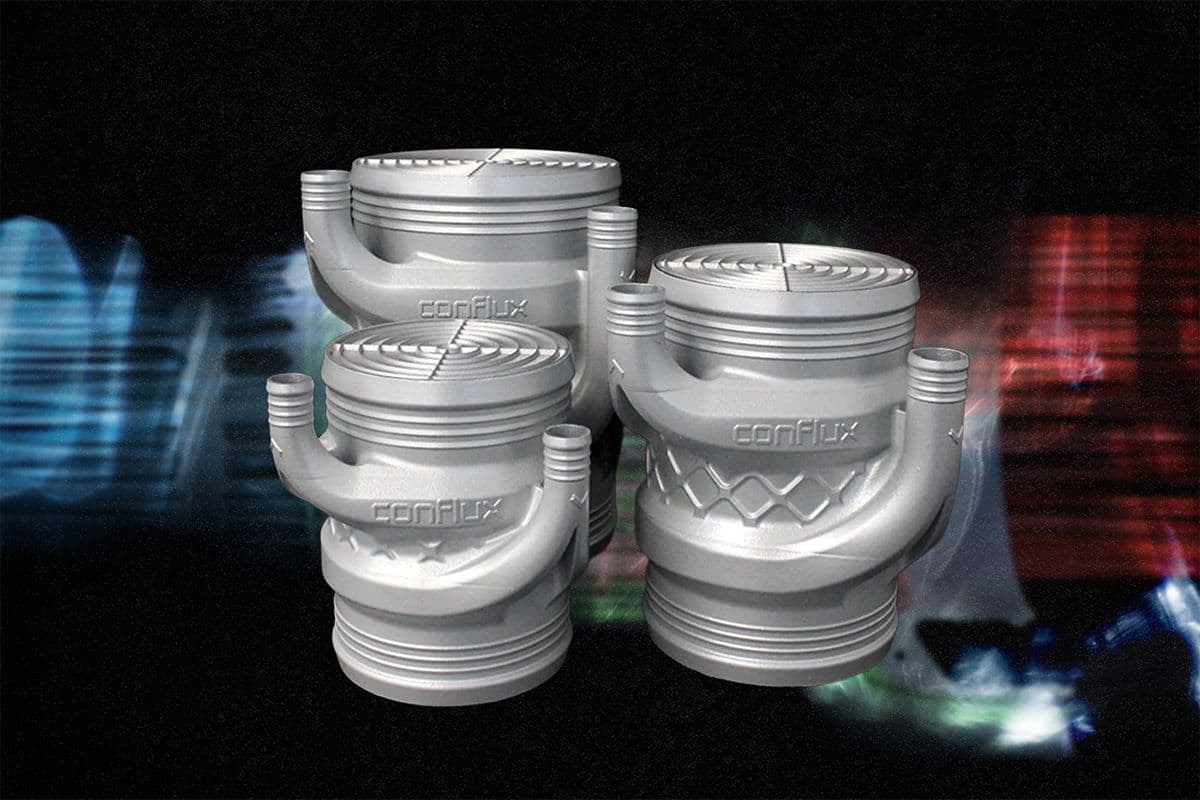
Every size in the range shares the same printed core design.
© Conflux
How To Buy One For Your Own Car
Theres no conventional ecommerce “add-to-basket” button.
You enquire, request data, and Conflux helps you choose. Three production-ready sizes are available:
| Diameter | Power Suitability | Measurements | Weight (dry) |
|---|---|---|---|
| 4.5" | up to 550 hp | 140 x 133 x 155 mm | 1.5kg |
| 5.0" | 400 to 800 hp | 160 x 150 x 190 mm | 2.2kg |
| 6.0" | 650 to 1,200+ hp | 177 x 171 x 225 mm | 3.4kg |
Like turbos, the numbers overlap. If you're making 500 hp today and planning more, the 5.0 inch gives you headroom without a second purchase.
Fitment is more flexible than I’d have expected initially. If none of those fit, you can configure barrel length up to 390 mm, air connectors up to 8 inches in hose barb, flat or V-flange form, coolant connections in AN/ORB, BSP/BSPT, NPT, JIC or Wiggins, and the coolant port orientation.
The route to market right now runs through three groups: low-volume manufacturers like Donkervoort, race teams, and specialist builders doing custom water-to-air conversions. My expectation is that UK enthusiasts will see these through motorsport fabricators and engine builders long before a mainstream parts retailer stocks them for you to buy off the shelf. Specialists will likely design kits to make them bolt on with no fabrication for specific vehicles and variants.
Remember there is more to consider when removing old parts entirely such as an intercooler. Especially if, like on some modern vehicles for example, you have an air conditioning condenser that bolts to the intercooler. You’ll need to be able to mount it.
Should you enquire, ask for these specifically:
How Much Air Your Engine Uses
Log it from your MAF sensor, or estimate it at roughly 1 lb/min of air for every 10 hp. Horsepower alone doesn't tell the full story, because the core only cares about the air passing through it.
How Hot That Air Is Before and After Cooling
Your IAT sensor shows the after figure. A second sensor between the turbo and intercooler shows the before figure. Ask Conflux what outlet temperature their core will deliver at your airflow.
How Much Boost the Core Will Cost You
Every intercooler loses some pressure. Ask for the pressure loss at your peak boost, and check yours today with a gauge either side of your current cooler.
How Much Water the Core Needs
Ask for the coolant flow rate in litres per minute, then check your pump can deliver it. Running the return line into a jug for 30 seconds is a quick, honest test.
Fittings That Match Your Car
Measure your boost pipe diameter and note your hose fittings, so the barrel arrives ready to connect without adaptors.
What It'll Cost You
I wish I could tell you how much they cost but Conflux doesn't quote prices. I’ll likely look into it myself or work with my network to find out. What their website does say is that their water charge air cooler is positioned at a fraction of typical microtube system costs.
Read that carefully.
Microtube is the motorsport benchmark, and it's expensive. The comparison isn't the cheap tube-and-fin barrel you'll find on eBay and other generic aftermarket manufacturers. I can confidently tell you to expect a significant premium over conventional aftermarket cooler cores.
The barrel is also only one part of a water-to-air system. Modern engines will be much easier to integrate into an existing engine configuration. The main design alteration is going to be the boost pipework and fittings.
For an older engine, I would budget for:
- A low temperature radiator up front, sized for your heat load
- An electric coolant pump, ideally ECU controlled rather than on a simple relay
- A header tank and coolant lines with the right fittings
- Fabricated boost pipework to the new barrel location
- Intake and coolant temperature logging so you can prove it's working
- A remap to take advantage of the cooler charge
Is it worth it? That’s the ultimate question. My answer to that is:
It depends on what you're building.
If you drive an EA888 Golf or an N55 BMW with a decent front mount, no.
For simplicity and price, a well-engineered bolt-on cooler already solves your problem for far less money, and I covered why in another one of my articles "Your Stock Intercooler's the Problem".
If your car already has a charge cooler or you're converting to water-to-air anyway, or you’re fighting for space in a mid-engined or twin-turbo layout, or perhaps you’re counting every kilo on a time attack car, this is the one I'd look at first.
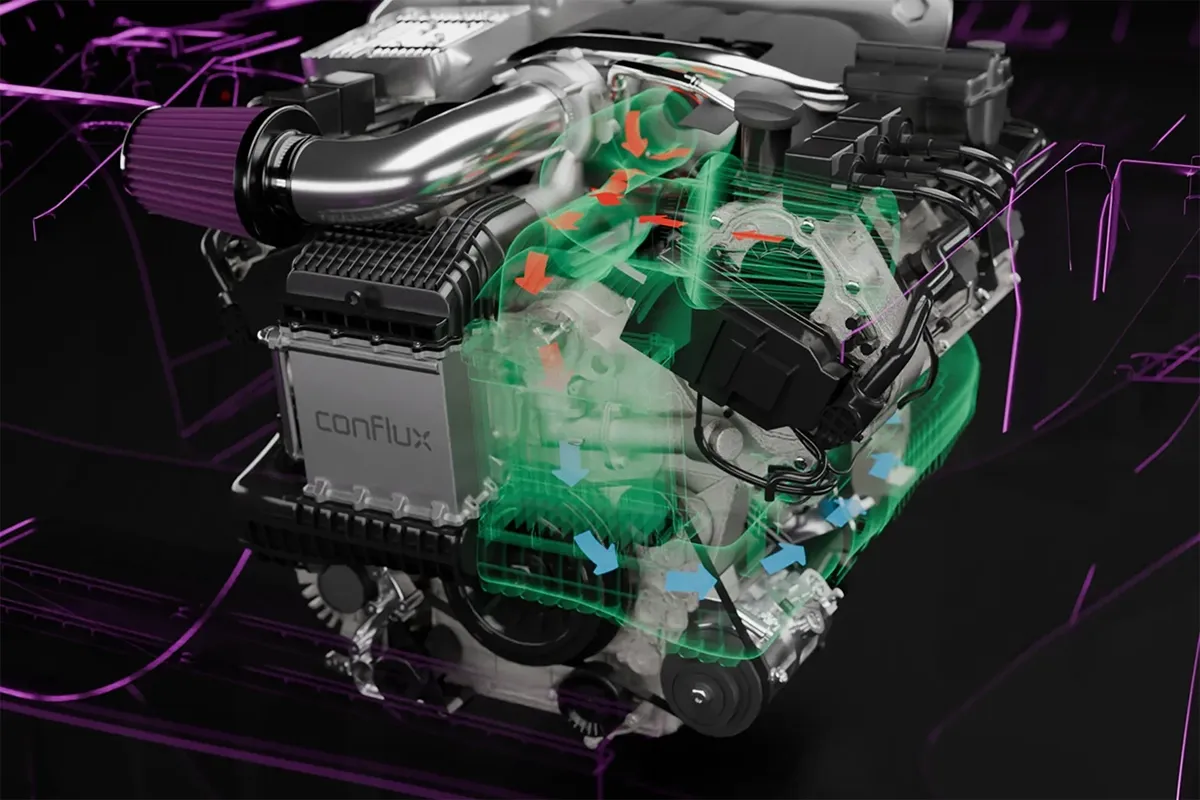
A Conflux charge cooler packaged for a production engine.
© Conflux
What It Means for Racing, Enthusiasts and Manufacturers
For racing, a configurable off-the-shelf part changes the metrics. Racing team designers won’t need to fund a bespoke cooler development programme. Conflux pitches its water charge air coolers on lightweight construction, configurable pressure drop and heat rejection, and compliance with cost caps. At club level, the same logic suits hillclimb, sprint and time attack cars where pipe length and mass count.
For enthusiasts, it's the first time a cooling part with genuine Grand Prix lineage can be bought through an enquiry form. Early adopters be aware, you’ll pay the most. That’s usually the case.
For manufacturers, the limit is volume. Additive manufacturing doesn't yet make economic sense for something like a Toyota Corolla radiator. Fuller does expect more markets to open up to the technology over the next five to ten years, and the intercooler is described as ready for Ferrari, McLaren and Aston Martin level volumes.
3D printed F1 parts are now being built into road cars and the performance jump is incredible.
Limited-run hypercars first, then supercars. Would you bet against a performance hatchback running one within the decade? I wouldn't.
I think we’ll find out soon enough.